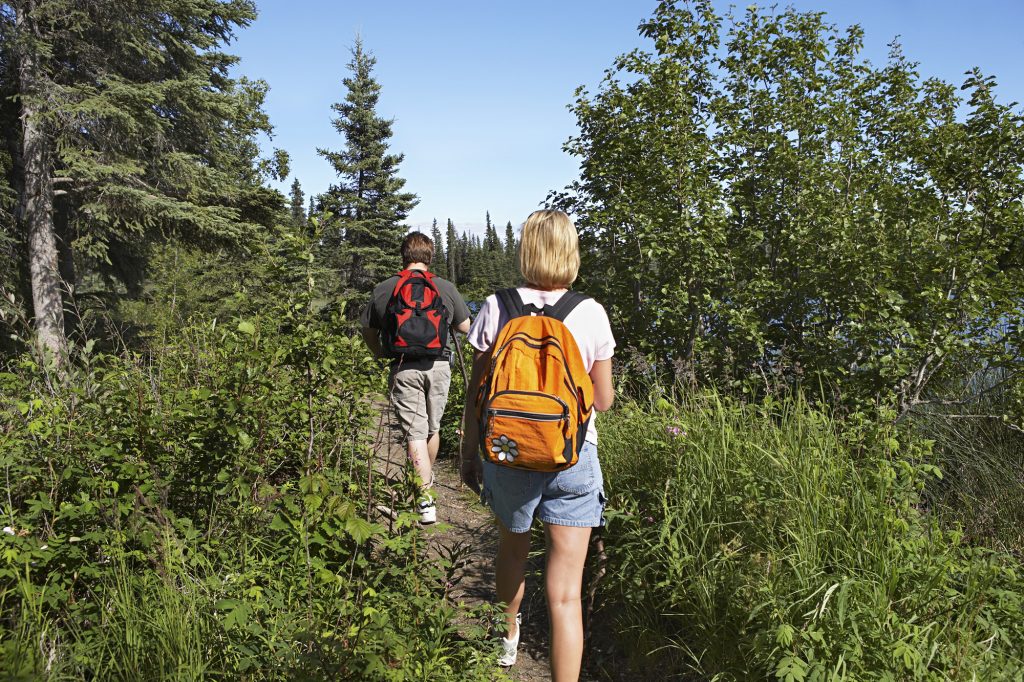
Who Yields When Hiking?
So you’re out hiking and you see someone coming toward you. What do you do? When passing someone on a trail it is expected for one party to step to the side and yield the walkway until the other party has passed. But who has the right of way?
Hikers vs. Hikers
Hikers going uphill always have the right of way. Hikers going up an incline have a smaller field of vision. The hiker going downhill has a much better vantage point and can see what’s coming up better than the hiker going uphill. Also the uphill hiker has to push themselves harder to get uphill and you don’t want to break their “hiking rhythm”.
Often an uphill hiker may yield to others coming downhill while they take a breather, but remember that’s the uphill hiker’s call.
Experienced hikers often pass slower hikers from behind. If you’re about to pass another hiker from behind, a simple “hello” is often the best way to let people know you are there. Many times people are so focused on what they are doing or what’s ahead on the trail that the fail to notice someone coming up behind them, especially on those long, steep inclines.
Hikers vs. Mountain Bikers
Many people think that hikers should yield to mountain bikers, however most hiking organizations specify that mountain bikes are expected to yield to hikers since mountain bikes are generally considered by these groups as more maneuverable than hikers’ legs.
I always yield to mountain bikers personally because they travel a lot faster than I do and I don’t want to feel rushed, like they are breathing down my neck. And it only takes a few seconds to yield and let them pass.
Hikers should also be aware of their surroundings on shared trails since a biker can apper suddenly around a turn or at the top of a hill coming down. Courteous and experienced mountain bikers will call out as they come down steep slopes or blind turns, and typically let you know if there are other bikers behind them.
Hikers vs. Horses
Horses always get the right of way on a trail, as they are hard to maneuver and can be unpredictable, especially when spooked.
If you come across an equestrian, give them as wide a berth as possible. Be sure not to make abrupt movements as they pass and talk quietly or avoid talking when approaching a horse as they can be easily startled.
If you’re on a narrow trail and horse is passing, get off the trail on the downhill side as they pass. Horses are more likely to run uphill than downhill when spooked, and you definitely don’t want to be trampled by a spooked horse.
Hiking in Groups
Trail etiquette is even more important when you’re hiking in a group. Groups should hike in a single-file line. A group should never take up more than half the width of trail space and should stay on the trail itself.
When a group is passing a single hiker, the single hiker should yield to the group and step to the side of the trail.
Letting Others Enjoy the Trail
Hike quietly. Speak in low voices and turn your cell phone down, if not off. Enjoy the sounds of nature and let others do the same. Loud noises might spook animals, and cause them to run away, which will keep others from enjoying them.
If taking a break, move off the trail a ways to allow others to pass by unobstructed.
Changing The Environment
Sometimes people remove rocks from a stream for a keepsake. This can be disastrous for the animals living there. Rocks in streams are critical for a many animals, especially young insects and amphibians.
You could be lifting the roof off the home of a crawfish or destroy eggs from an endangered species. Even worse, if rocks are removed from a stream bank, it can lead to additional and quicker erosion and cause permanent damage of what may already be a fragile ecosystem.
Some people build cairns (stacking rocks) with rocks, which once again can disturb the ecosystem by removing rocks from streams. Cairns were originally designed to mark safe trails. Adding cairns can cause a hiker to venture onto an unsafe trail or cross a stream that should not be crossed (due to depth or currents).
Leave the Trail The Way It Was
Pack it in – Pack it Out
Don’t toss your trash, not even biodegradable items such as banana peels. It’s not good for animals to eat non-native foods. Food trash also draws in animals, which can lead to an animal on the trail (which in many cases if a bear is on the trail, rangers will close down the trail until the animal moves on its way) or animal droppings that you will have to dodge. If you brought it with you, take it back with you.
Dogs and Other Pets
Before bringing a dog with you, check to see if they are allowed. Pets, especially dogs, are prohibited in many places. One such place where dogs are prohibited is the Smoky Mountains, but we’ve seen plenty of other trails, and you don’t want to leave your favorite pet in a hot car, so check first.
When bringing a dog with you on a hike, be sure to keep it on a leash and under control. More than once we’ve had “normally calm” dogs barking and charging us as they get over stimulated from the new sights and sounds that they have to deal with… including the immense wildlife they are not used to. Of course, don’t forget to pick up your dog’s poop if it is on the trail. No one wants to step in poop.
Interacting with Wildlife
Don’t feed or disrupt the wildlife. While many animals stay hidden, others are not so shy. Giving them food can take away their fear of humans and have let to them being put down in several cases. It also can cause them to become reliant on humans for food instead of their natural foraging skills.
Final Thoughts
Leave what you find. The only souvenirs a hiker should come home with are photographs and happy memories. That way other people can enjoy what you did… and a courteous hiker is a happy hiker.
Leave a Reply