A Journey Through Time at the Harrisburg Covered Bridge
Hidden among the quiet backroads of Sevier County in East Tennessee, the Harrisburg Covered Bridge stands as one of the state’s most enduring historic landmarks. Spanning the East Fork of the Little Pigeon River near Sevierville (near Pigeon Forge and Gatlinburg), the bridge is more than a scenic photo stop – it is a rare surviving example of nineteenth-century American bridge craftsmanship.
Historically, Tennessee once had numerous covered bridges during the nineteenth century, but floods, fires, modernization, and highway replacement projects gradually eliminated most of them. Tennessee currently has only six remaining covered bridges, although only five are considered historic/authentic covered bridges.
Built in 1875, the Harrisburg Covered Bridge has witnessed generations of Appalachian life. Farmers, blacksmiths, mill workers, horse-drawn wagons, and eventually automobiles all passed beneath its timber roof. Today, travelers who discover it are rewarded with something increasingly rare – a place where history still feels alive.
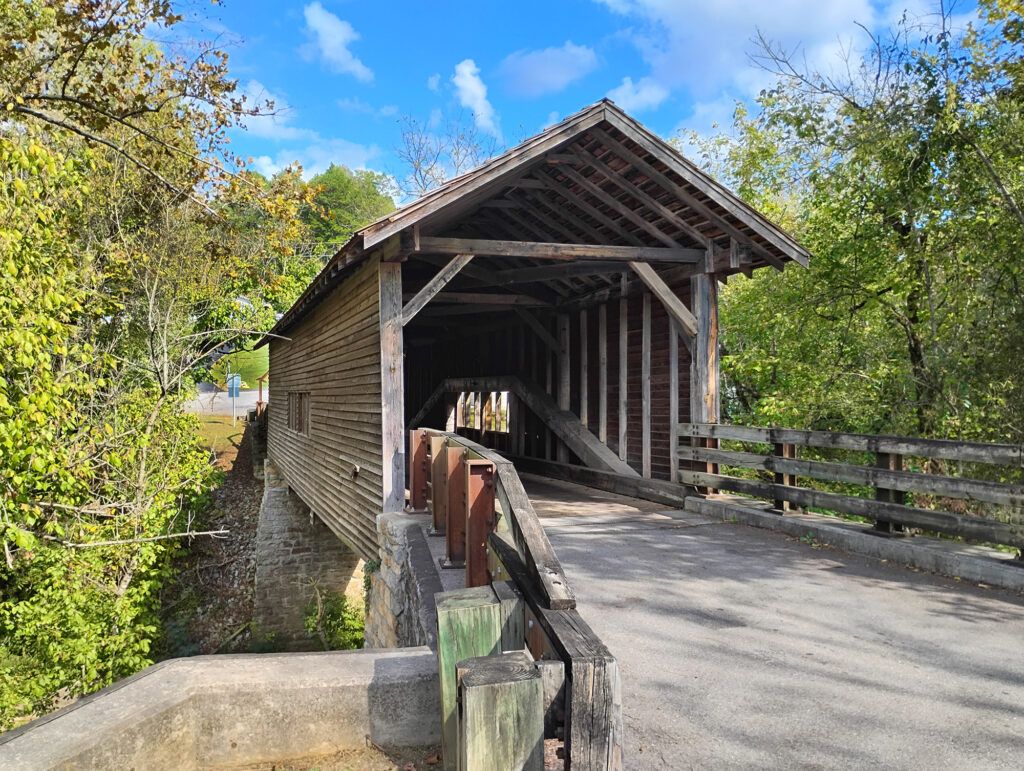
The drive to the bridge is part of the experience itself. Rolling Tennessee hills unfold into quiet farmland, and the road narrows as if preparing visitors for a slower pace of life. Then, suddenly, the bridge appears with its long wooden walls, a pitched metal roof, and a rustic silhouette reflected in the river below.
What makes the bridge especially remarkable is its survival. The Harrisburg Covered Bridge is the oldest of the three historic covered bridges that are still open to motor vehicle traffic. Unlike many historic structures that survive only behind fences or museum ropes, or open to pedestrian traffic only – like the Eilizabethon Covered Bridge, the Harrisburg Covered Bridge remains functional and open to traffic.
The original McNutts Bridge once stood nearby but was destroyed by flooding in 1875. Local residents rallied together to rebuild the crossing, donating labor, timber, and money during a time when communities relied heavily on one another. Elbert Stephenson Early, a local craftsman and builder, led the construction effort, creating a bridge sturdy enough to endure nearly a century and a half of weather, floods, and changing times.
During the late 1800s, the Harrisburg community flourished around the bridge. Mills operated nearby, blacksmith shops rang with the sound of hammering steel, and families traveled the road connecting farms and markets throughout East Tennessee. But when newer roads bypassed the community in the early twentieth century, Harrisburg slowly faded into a quieter existence. The bridge, however, remained.
By the 1970s, the structure had deteriorated badly and faced possible demolition. Fortunately, local preservation groups – including chapters of the Daughters of the American Revolution – stepped forward to save it. Restoration efforts preserved the bridge’s historic character while strengthening it for future generations. In 1975, it earned a place on the National Register of Historic Places, ensuring its story would continue.
Architecturally, the bridge is constructed in the classic Kingpost truss style, one of the oldest and simplest bridge-building methods used in rural America during the nineteenth century. The Kingpost design relies on a central vertical support beam connected to angled braces, creating a strong triangular framework capable of supporting heavy loads while using relatively little material. This practical engineering style made covered bridges affordable and durable for small farming communities across Appalachia.
The bridge’s exterior reflects traditional covered bridge construction of the period. Its long timber-sided walls and pitched metal roof were not built merely for appearance – they served an important purpose. Covering the wooden trusses protected them from rain, snow, and harsh weather, dramatically extending the lifespan of the structure. In fact, many uncovered wooden bridges of the same era disappeared decades ago, while covered bridges like the Harrisburg Covered Bridge survived because their roofs shielded the critical support beams from rot.
Inside, the bridge reveals hand-hewn timber beams darkened by nearly 150 years of age. Sunlight slips through narrow gaps in the siding, creating shifting patterns across the wooden floorboards. The scent of aged timber and the echo of tires crossing the planks give visitors an immersive sense of history rarely found in modern travel destinations.
Visiting the Harrisburg Covered Bridge today is not about crowds or commercial attractions. It is about atmosphere. Early morning fog drifts above the river, birds call from the trees, and sunlight filters through the wooden slats inside the bridge. Photographers are drawn to its symmetry and texture, while history lovers appreciate the craftsmanship of its hand-built trusses and weathered beams.
Autumn may be the most magical season to visit. The surrounding hills burst into shades of amber, crimson, and gold, framing the bridge in classic Appalachian beauty. Yet even in winter, when frost settles on the wooden roof and the river runs cold beneath it, the bridge carries a quiet dignity that feels timeless.
The Harrisburg Covered Bridge reminds travelers that some of the South’s greatest destinations are not flashy or famous. Sometimes they are hidden in the folds of the mountains, waiting patiently beside a country road. For those willing to slow down and wander beyond Tennessee’s busiest tourist routes, this historic bridge offers more than a scenic stop – it offers a connection to the enduring spirit of rural Appalachia.
Leave a Reply